Kolkatta HC upholds marriage of Hindu minor girl by Muslim goonda

December 29, 2009 by arisebharat

Namaste

This is the sort of callousness by the judiciary and administration which encourages the Muslim goondas. When the administration and judiciary join hands with the goondas, it is for the people to ensure that justice prevails.

“Love Jihad” launched seems to be a nationwide conspiracy which must be put down with an iron hand…if not by the government, then by the people of Bharat.

Arise Bharat.

Ayush

http://timesofindia.indiatimes.com/city/kolkata-/Youth-gets-bail-in-elopement-caseKolkata/articleshow/5345745.cms

KOLKATA: Calcutta High Court on Wednesday granted the anticipatory bail plea of a 26-year-old youth from Murshidabad who had been accused of
kidnapping and marrying a 15-year-old girl.

Sairul Sheikh, a resident of Bakultala in Behrampore, had been accused of kidnapping and forcibly marrying Anita Roy.

A division bench of Justice Pinaki Chandra Ghosh and Justice S P Talukdar allowed Sheikh’s plea after his lawyers Joymalya Bagchi and Rajib Lochan Chakraborty submitted that the marriage was legal under Muslim Personal Law. Holding the marriage legal, the court granted Sheikh’s anticipatory bail application.

Anita’s mother Jyotsna had lodged a complaint with Behrampore PS that her daughter had been missing since October 14. On October 15, she came to know that son Sairul had “kidnapped and married” her minor daughter.

More info at http://www.faithfreedom.org/islam/foolish-judgment-calcutta-high-court

FAQ’s on Hinduism

November 28, 2009 by arisebharat

 A Guide to Answer  Some of the Frequent Questions/Criticisms  Against Hinduism   - A Practitioner’s Perspective  by  Veera Skanda

 Contents

 Introduction 

  1. Is Hinduism a religion or a dharma or a way of life? Rather, what is Hinduism?
  2. What is good in caste?
  3. Is caste determined by birth or by qualities?
  4. Discrimination and exploitation – does caste create or control these?
  5. Does Hinduism need to be protected by VHP and the likes?
  6. Tolerance is in the Hindu philosophy but not in its religion
  7. What good is spirituality if it can be understood only by few?
  8. All religions worship God, preach salvation. What is so great about Hinduism?
  9. Did God create man or has man created God?
  10. Do gods get angry?
  11. Who worships Gods and who worships devil?
  12. Who is fit to preach? Hindus do not even worship God but only the forms of creation!
  13. Is religion bad or the followers bad?
  14. Is animal sacrifice not cruel and violent?
  15. Hindu Gods hold weapons, and their stories are about fighting – how does Hinduism preach nonviolence? Also, if these wars are said to be for a noble cause, are not crusades and crescentades the same? Why then is so much fury about those?
  16. Do Vedas have science? Is it not too much to claim that?
  17. Hindus claim that Vedas and Agamas to be revealed scriptures, so do the Abrahamists. So how does Hinduism become any more non-dogmatic than the latter?
  18. Religion is the reason for dogma, it has caused bloodshed and is anti-science.
  19.  
  20. How are women treated in Hinduism?
  21. Superstition and religion
  22. Force-guidance-handholding in religious practices
  23. Untouchability
  24. Single vs multiple gods – lack of clarity or better direction?


 Introduction

 This is a compilation of frequent criticism/questions on Hinduism, along with brief answers from a practitioner’s perspective. The length of these answers and the taste in which the questions are often posted hardly give scope for explaining the broad and lofty system of traditions that Hinduism has. This is an essential attempt to meet the question-and-run type criticism where the questions need profound understanding of many subjects to be addressed but discussions seldom give scope for such understanding or explanation. Most of the times, those who raise these questions hardly have authority on the subjects and concepts involved. However that is serving their purpose – to raise these fundamental questions in the minds of less aware Hindus. And in many occasions, in the light of lack of readymade answers, less patient Hindus tend to give benefit of doubt to the questioner – and this is harmful, as it paints a negative image of Hinduism to the common man and confuses believers. There are many kinds of people who raise these questions – right from the innocent to those whose intention is to malign the great tradition.

 Much of the answering contrasts the oriental and Abrahamic worldviews, for multiple reasons –

  • The contrast is easily visible and that makes things easily understandable.
  • The difference needs to be understood and one should understand that evaluating any tradition needs to be done within the framework of its concepts. Most of the times we tend to evaluate the oriental traditions using the concepts and terminology of Abrahamic traditions and western worldview, which is hardly sufficient to explain, understand or evaluate the diverse and lofty oriental traditions.
  • Most of the criticism is done by the followers and promoters of Abrahamic systems, therefore one should understand the worldview adhered to by the critics and also the system they are criticizing.

 The answers are not really targeted to a specific audience but intended to give a quick clarification on these. Those who are interested in understanding the concepts and the core of the tradition are advised to consult classical texts, learned men and practitioners of Hinduism. The answers are also not complete in the sense that they do not address the diverse schools of Hinduism – each school has its own approach to the fundamentals. Therefore it would be simplistic even to attempt to give a blanket statement to represent the whole system. However, all the schools are broad and lofty, and though they differ in their approaches they are all based on a thorough understanding of life, consciousness and human nature – which makes them correct, all at the same time with all the differences. The material used for these answers is compiled from various sources on Hinduism, some of them online and some of them printed texts.


Question

 Is Hinduism a religion or a dharma or a way of life? Rather, what is Hinduism?

 Answer

 Hinduism is a loose word that refers to the original Indian culture, its society and its varied spiritual traditions.  There are different contexts in which one would seek to define Hinduism – spiritual traditions, social fabric, civilization. There are varied spiritual traditions native to India – Vedic-Tantric, Bauddha, Jaina, Sikh and so on. Some of these do not call themselves part of Hinduism in the sense that they do not subscribe to the Sanatana Dharma, and its Vedic-Tantric worldviews. They are however part of the same civilization and society. Thus there is a civilizational and a spiritual tradition specific demarcation.

 The need to define Hinduism arises primarily because of the need to assert a civilizational, cultural and spiritual identity and differentiate it from the totally alien worldviews like the Abrahamic traditions. Until they have invaded India, there was hardly a need for a collective definition – there are Vaishnavas, Saivas, Saktas, Ganapatyas, Bauddhas, Jainas, Srauta-Smartas, Nastikas and many more. All these sprouted from the same civilization, have coexisted with each other for millennia with the diversity of their worldviews. Their differences and diversity have only enriched the knowledge system of the civilization. The civilization that had all these systems is truly so universal in its nature, that it could accommodate virtually any worldview provided it fits into the pluralistic system and agrees to coexist with others.

 The whole thing changed with the invasion of exclusivist and intolerant Abrahamic traditions. And there came the need for the otherwise unconditional and universally accommodating society to put a definition, a boundary to preserve itself. In that sense, Hinduism is a social level definition intended for a practical purpose. However the very nature of society it represents has many aspects – civilizational, religious, cultural and social. Hinduism is not a society, a culture, a civilization or a group of religions – it is all this and more than this. It is a comprehensive system of life encompassing a collection of tolerant and pluralistic spiritual traditions, their collective knowledge system and wisdom, the society they built up, their civilization and the whole range of cultures and customs they practice.

 However when the word Hinduism is applied to a religion, one usually refers to its Vedic-Tantric traditions such as Smarta-Srauta, Sakta, Vaishnava, Saiva. This excludes Bauddha, Jaina traditions. By saying Hinduism in this context, one is referring to Sanatana Dharma, whose corner stone is the Varna-Ashrama Dharma. Dharma/righteousness is its foundation rock. The traditions such as Bauddha that do not subscribe to it fall outside its fold in that sense. However, they all have a higher level of similarity with Sanatana Dharma in their spiritual practices, their pluralistic nature and the knowledge system consisting of sciences, arts and metaphysics that they contributed to. Bauddha even bases itself on Dharma, though it does not subscribe to the Varna system.


Question

 What is good in caste? It has always been a vehicle of discrimination, a social stigma.

 Answer

 Caste system is one of the primary and defining features of Hindu society, and its armour. That is the reason its enemies have targeted it. And ignorant Hindus are buying the arguments of their enemies. If we look at facts - 

  • Caste/jati is an endogamous cultural unit. Hindu society is a group of jatis. In fact the word Hindu itself is not very rigid here, any culture/religion that came from outside India such as Parsis or Jews are treated as jatis and allowed to preserve not only their religion and theology but their customs and cultural traits.
  • Caste is one of the primary contributors to pluralism and coexistence in India.  Communities right from those millions strong to those that hardly have thousands of adherents, have retained their cultural identities, their uniqueness, their autonomy for millennia in India alone, and jati/caste is the organization that made it possible. Smaller and weaker communities all over the world have lost their identity and existence in front of bigger communities – even million strong communities a couple of thousand years ago are not even to be seen today. In contrast even small communities in India have retained their identity.
  • Caste creates social capital, caste offers strength to the society. It is the intermediary level of collectivity smaller than nation individuals identify themselves with.
  • It is the endogamous cultural unit, and preserves the cultural diversity in the society without eliminating it in the name of uniformity.

 On the other hand -

  • People who criticize caste system for discrimination do not differentiate between feudal and caste systems, untouchability and hatred. They fail to see that caste has not created the feudal setup – on the other hand it had to some extent brought down the strength of feudal setup.
  • People who cannot even create an organization of hundred men without grouping and classifying them, who talk loud about caste but do not even refrain from discrimination in their own lives, who cannot even avoid such breed/brand/class discrimination while choosing their pet dogs and their partners, are the ones who unfortunately get to talk about social dynamics and discrimination. They hardly have any right to give lectures about those.
  • Those who had the understanding of Hinduism, those who genuinely wished for the good of Hinduism have always tried to reform the caste system, to advocate against caste-rivalry but never went against caste itself.

Question

 Is caste determined by birth or by qualities? How does it ensure social mobility?

 Answer

 There are two aspects in the caste system – jati or the cultural unit and varna, the higher abstraction. Jati is very much determined by birth. Varna is explained in two ways – one is the abstraction over Jati. Any Jati by its predominant occupation falls into one of these. The other is not a categorization but a description. Any society has four kinds of people. Its four pillars are the knowledge institution, governance and defense, commerce, vocations. This is not segregation but a commonsense description of any society.

 While evaluating caste, two things are generally ignored –

  • the difference between jati and varna, and the two faces of varna
  • the fact that jati is the social unit while varna is only an abstraction, not an arrangement

 In any organized society, there are two things to be ensured – social mobility and security. Protection or security in Hindu society is ensured through the jati system, both by distribution of power centers (and thereby preventing any single group from assuming the power) and by strengthening/protecting the autonomy of each group. This is not theory, but this is how the strong castes we see today have developed – by strengthening the bond between individuals and the caste unit. On the other hand the castes where individualism takes precedence over group identity have remained weak as groups.

 Varna on the other hand, is about creating synergy between individuals and groups that perform the four major social functions mentioned above.

 Social mobility is of multiple types Mobility could be at individual, group or jati level -

  • Mingling of individuals and groups at different capacities, their synergy and protocol of interaction to prevent a stronger group from taking advantage of a weaker group. An individual with his merit, can move to another Varna. This depends on the merit of the individual, the eligibility to pursue the function of a Varna, the teacher he seeks and so on. Examples:
  1.  
    • Many rishis born as non-dvijas, Sudras like Vidura taking up ministries.
    • Many persons with study or yoga becoming teachers today
  • Through inter-jati marriage an individual can move from one jati to another. This has some regulations. In a patriarchy, a woman moves to the jati of her husband. In matriarchy, it is the other way round. There are very few matriarchic societies in India, like in Kerala. This however does not change the varna/function of the individual. Examples:
  1.  
    • All inter-jati marriages.
    • Many brahmins losing their varna because of not practicing their varna dharma
  • Marriage across jati results in change of caste.  In a patriarchy (most of the communities are patriarchies these days) the woman takes her husband’s jati. In a matriarchy the man takes the woman’s jati. However, the varna does not transform still, even after change of jati.
  • Change of varna in case of individuals, through initiation into learning given by a learned man.
  • An entire group of individuals could move to another Varna, because of the role they play in a social situation. Examples: Many non-Kshatriya jatis becoming Kshatriya jatis as they took up military defense during Muslim invasions.

Question

Does caste system not create discrimination, inequality and scope for exploitation?

Answer

People who say this, are either ignorant of the basic workings of human nature and society, or deliberately attack the Hindu society. Inequality and segregation is not created by caste system, rather they are inherent in human nature and society. What caste system aims at is not to deny that fundamental fact, but rather to address and control these to the extent possible, so that it is least harmful the society. The fact that Hindu society had survived over ages, while most societies have broken up and were replaced by different civilizations multiple times in the same duration, stands to say this. Far from the picture of oppression that is often painted against Hinduism, the fact remains that there were hardly caste level clashes in Hindu society before foreign invasions done by the Muslims and Christians (Europeans). The natural differences and discrepancy that no society could get over, is not created by, but rather kept by the caste system under check.


 Question

Hinduism is not so weak that it needs to be protected by those like Bajrang Dal or VHP. It has withstood various onslaughts over centuries and continues to survive. Why does it need to be campaigned for or defended?

 Answer

 This is one of the most common arguments, but those who do such arguments fail to answer the question – “how did it withstand those onslaughts?” It did, by defending itself from those, physically, militarily – when “fanatics” of yore fought for it. And that is what follows from commonsense – something will survive when it has warriors to defend it. Hinduism did not survive by itself while monks kept closing their nostrils. It survived because of its warriors who defended its “fabric” by the strength of their swords.

And even today, as commonsense suggests, it will survive only when it is defended. The difference today, however, is that it does not have a military to defend it. There are only these so-called fanatics!! So you either leave it to them, or take it upon yourself to defend the rare, great and tolerant system.
It retained its culture, its social fabric by the strength of its warrior class, by the blood of millions of its warriors, its soldiers. It is a naive and/or hypocritical to show the very survival of Hinduism as proof for the lack of need for its protection, because such tolerance would survive only when it is defended, when the intolerant tribes attacking it from all ends are controlled. It is very well known from whom Hinduism is trying to defend itself, for the past thousand years, continuously losing its people, its land, its culture, its fabric. Once a grand culture that spread out in many places in Asia, it is now reduced to less than a dominant Hindu nation – with even that being a secular nation where it hardly finds the leadership favorable to defend it. The continuous and fast diminution in the following of the tolerant culture and the steep rise in the intolerant tribes that are attacking it, would cause concern not just to a practicing Hindu but any tolerant and peace-loving human being.
Question

 The tolerance of Hinduism is in its philosophy, not its ritual/dogmatic part.
Answer

 There is just one Hinduism – philosophy, culture, religions are only different aspects of it. And Hinduism is evolving, synthetic, accommodating and flexible in all these aspects.

Whatever customs one sees, one should understand that they are specific to the tradition that follows those. And there are several traditions – following different customs, rituals, practices and philosophies. And a common Hindu follows any of those traditions or even remains outside those. One still very much remains a part of the Hindu society. This flexibility in Hinduism is not because of the “philosophy”, but a flexibility that comes by drawing the line between religion governance and society, and minimizing the interference of one on the other. This is the uniqueness of Hinduism – to have a comprehensive system of life and still being able to keep the various aspects of life in proper context.

 There are multiple religions in Hinduism, multiple traditions and philosophies. To call it a philosophy is in itself simplistic. It is a system in which religions, philosophies, arts and sciences have thrived, reinforced each other. Its religions have only furthered the study of sciences and pursuit of arts, and bulk of its knowledge lies in the various spiritual traditions. Unlike the west, the Hindu knowledge system is a single structure where philosophy, arts, sciences, worldviews share a common base.

 The tolerance in Hinduism therefore is not in spite of its religions, but because of the religions and the philosophies that guide them.

Question

 What good is spirituality if it can be understood by only few individuals or priests?

 Answer

 Let us raise an equivalent question. What good is science, when it is understood only by a few researchers, and when people by and large are not aware of its complex theories? The answer is simple too: because most people use it, benefit by it, though they do not know its intricacies. Scientists bring science into the hands of technologists, and the way technologists develop socially useful contrivances based on that science. Similarly seers bring religion into the hands of practitioners and teachers, who in turn package it for the practice/belief of a common man. Just the way a scientist questions and existing scientific theory, a seer questions a spiritual philosophy. Just the way a technologist uses different theories to different ends, a teacher/practitioner develops different methods/practices to suit different people and different situations. Just the way a science understood only by a few is called mainstream knowledge spirituality too is the essential knowledge for mankind.


Question

 All religions worship God, preach salvation. What is so great about Hinduism?

 Answer

 Typically people who say this, are Hindus. After all, if all religions worship God and preach salvation, then why does one need to persecute, attack, insult and mudsling the gods of other religions? Why does one need to destroy the places of worship of other religions, conduct riots, murder, arson, loot on the followers of other religions? Why does one need to create havoc, exterminate tolerant civilizations and religions if all one needs is to preach love? Why are some religions tolerant, accommodating and pluralistic while some are intolerant, exclusivist and below basic morality?

 No, all religions are not the same. Some religions preach love and salvation, while some are vehicles for imperialism in the name of preaching. For them preaching is not a matter of sharing their knowledge, because they themselves have no knowledge about divinity or even humanity.

 Here is exactly where we understand the greatness of Hinduism. Unlike the Abrahamists who have long missed the fundamentals of humanity, forget divinity and salvation, Hinduism has understood those. It has understood that organizations to preach religion are not beyond human weaknesses and they will become vehicles of imperialism just the way Church and Islam have become. It aims at expanding human mind into its higher reaches, into freedom unlike the latter that have learned only to curb it and even encourage its lowest instincts in the name of divine sanctions. That is the reason why one finds sublime spiritual philosophies in Hinduism. Not one but many philosophies coexisting, contributing to a comprehensive knowledge system, developing a wide range of theologies, spiritual traditions. Even the conflicts between those schools have only enriched them into more comprehensive and complete schools – unlike the conflicts with Abrahamists which were socio-political and military – nothing of the sort or anywhere near the profound system that Hinduism is.

 Faith is only preliminary in religion. Its higher reaches are freedom and expansion. The Abrahamic cults exhibit nothing of that sort. All they know of is to curb freedom, sanction sense and ego gratification irrespective of morality for all the “believers”, to preach hate against fellow human beings by drawing an artificial line of disbelief in the place of an existent and important line – of humanity, morality, tolerance and freedom.

 And this is where one knows of the greatness of Hinduism – it has protected the institution of knowledge, the pursuit of truth and divinity. It has not allowed the claims of such pursuit to be a vehicle for imperialism or persecution or amoral sense or ego gratification. It created institutions that allow the quest for perfection, excellence, the pursuit of truth beauty and divinity, and the result is visible in the philosophies that scale the whole range of consciousness, in traditions that train individuals to expand the limited human mind into that infinite consciousness, to realize the farthest reaches of nature, to have a first hand experience of such consciousness and salvation.


Question

 Did God create man or has man created God? Is not all this just in human mind? Even if it is said that there is a God is it that not just the same concept or entity that all the religions talk of and worship?

 Answer

The original philosophical statement goes thus: “God created man in his own image, and man promptly returned the gift”. Man created God in his mind, his thought – that is not what God IS, but that is what man thinks of God.

 In that sense, yes man created God – and it is no sacrilege to say that.
Rather, it shows the paradox, the limitation of logic. The limitation of mind
and its necessity to “create”, to imagine instead of being able to SEE what is right in
front. It is also appropriate to recollect the famous Russel’s paradox – if God
is omnipotent, He can create a rock so big that He cannot lift it. So if he
cannot create such a rock, he is not omnipotent. If he can eventually create
such a rock, he again is not omnipotent because he cannot lift it! So who
created a God who is not omnipotent? Logic (rather its limitation) and nothing
else.

And it is actually true – every person, every collectivity has its own
conception of God – and that depends on how evolved that person or group is. An
average mind thinks of God as a person, a big mind thinks of it as a concept and
only a seer as a living presence. This is why we see so much of diversity in the
theologies of different societies – in societies that worship jealous and angry
gods, such theology only represents their collective psyche. And it is not difficult to see
that the highest they can understand is an average human quality like jealousy,
anger and at most forgiving (that too, not infinitely merciful but sectarian
enough to punish all non-believers and protect believers no matter how immoral
they are). In the societies where gods are infinite, beyond these qualities but
still causing all these at the phenomenal level to fulfill the divine purpose,
such concepts show their psyche – their understanding of the vast and causal
nature of the universe in sharp contrast to the former type where the understanding is (1) anthropomorphic (2) too terrestrial and narrow.

 Thus the more evolved man is, the less he will try to impose his image on god
and the more he tries to see for what god actually is. And that is the goal of
all sadhana – to get a first hand experience, to see what is instead of create
what we think that is.

 Therefore for people who say all religions talk of the same
God or supreme or “param satta”, the answer is that – the “param satta” as defined by someone and as it exists, an attempt to know it, the modesty to declare human incapability to understand it and only describe it in the most general possible way to be as accurate as possible, is the difference. The difference is of agency between the creator and created and living forever as a subordinate of such agents (who are themselves hallucinated, have no first hand experience of divinity and hence preach jealousy, hatred and anger), and acknowledging the fact that such first hand experience is the goal.

On the other hand, those who understand that a concept like God which is beyond mental impressions cannot be comprehended with limited human consciousness, does not claim to be “the only true religion” or his concept of God to be “the only true God”. He understands that his conception, knowledgeable or naïve, is only one of the several conceptions, some of them deeper and some shallow. Such a claim only shows how imperfect and ignorant one’s understanding is, of God, human nature and consciousness.

Consciousness and mind: The whole range of consciousness cannot be reduced
to mind. Seeing the whole world with mind’s eye is one of the several levels.
It is certainly mind that causes the senses to be conscient, and senses that
cause the body to be conscient. Upwards, it works the other way – it is the
intellect that governs the workings of mind. The four faculties of consciousness
- mind (manas), intellect (buddhi), ego (ahankara) and memory (citta) are
overlapping but distinct. Mind/conscient-proper needs an external or inner
inspiration – it processes either external impressions or those impressions that
are created from actions. So it depends on which impressions one chooses to feed
mind with, and that “one” who chooses is the intellect. Intellect too, does not
get to govern mind’s functions always. Many times, it goes unwatched – most of
the times it just repeates external impressions (that senses receive from the
world) and their memories. Some other times it digs from memory the impressions of previous experiences – and depending on the gross or subtle senses are active, these can be impressions recent or old or of previous lives. As one knows himself to be subtle body
instead of gross body, his experiences and impressions will be deeper, and will
not be limited to a present life. Since gross body is specific to a life, the
impressions and knowledge that is gained without shedding mind’s identification
with the body will be limited to that life. As one’s identity happens with the
subtle body (sukshma sareera), one knows himself to be more than carnal. With
subtle body yogas (kundalini, mantra, hatha, laya yoga etc) one can achieve this
through proper use of mind and intellect. However, the causal is beyond these -
it is neither experienced with these nor known through these. For knowing it the
only way is to dissolve the mind-intellect in causal being.

Residence of knowledge: Knowledge exists not in mind but in the parama vyoma.
It only reflects on the mind when one realizes it. Mind is only the upadhi for
knowing, and the means for descending the knowledge into one’s life.

Question

Do gods get angry? Are Hindu Gods not feared for the punishment they give? On the contrary, some religions only preach love for the God.

 Answer

As for love or fear, where is love for someone who cannot tolerate your
disbelief in him? In those cases, the God is himself not an unconditional lover! The point is about what you and your God think of those who do not care about or believe in your God. Hindu Gods never punish disbelievers or anyone for that matter, just because they do not have faith – according to the Hindu traditions the one who is righteous always receives the grace of God, irrespective of his faith. One who is unrighteous, receives the rotten fruits of his unrighteous deeds no matter how much of faith he professes.

Hindus never say daiva-bheeti (fear of God). Hindus say daiva bhakti (devotion to God) and papa bheeti (fear of being unrighteous) – be devoted to God and fear the unrighteous. In Hinduism, God is not the center-stage. Dharma is. The experiences one undergoes, according to Hinduism, follows the nobility of his own actions – God is only a witness to these actions and fruits, but not the one who gives punishments. One can be righteous get liberated without any God either by following the principles of Dharma or through devotion for God or by realizing the true nature of oneself. These three, righteousness, devotion and knowledge are three major paths to liberation in Hinduism.

 This is in stark contrast to the Abrahamic worldview where faith is primary and righteousness secondary. After all, one’s righteousness is of no use if he does not announce his faith is a wrathful God. It is from here that all the nobility of Hinduism and all the evil of Abrahamics sprout, from there that the tolerance of Hinduism and intolerance, exclusivist mentatily of Abrahamics comes.

In Hinduism, it is not ignoring them that makes Gods angry. It is invoking them for a purpose and then not propitiating them that causes undesired results. There is a lot of difference. And in this, it works the otherway way – the Abrahamic god hurts you even if you do not invoke him or do not believe in him. Our gods are not like that. If you leave them alone, they will leave you alone without hurting.

 Of course, there are terrible negative effects, if the path of worship is not followed properly. However it should be understood that it is not like an anthropomorphic God getting angry but the kind of energy generated when not channelized properly, causes negative effects to the one who invoked it. It is similar to a reactor lacking proper moderators. That is why elders say that practice should be done with due guidance from a learned man.

Question

 Who worships gods and who worships ancestors and who worships devils?

 Answer

Worship of God and forms of God – many religions in fact do not worship God. They just call it God, but it is not God. In fact, contrary to what they criticize the likes of Chinese both the anti-semitic Abrahamic religions are mane-worshipers. One would observe that their places of worship are always tied with burials. There is the two world and three world theory. In two world theory, they only have man and mane, no god. What they call God, has all the qualities of a mane, and not God. He is sectarian himself, angry, jealous all that a mane is and God is not. Hindus have a third world beyond the world of manes, which is the world of Devatas – who are beyond the outward impressions of mind like anger. These three worlds are ruled by earth, moon and sun. Vasu, Rudra and Aditya. Their time scales are day, month and year respectively. Beyond this, there are many levels and worlds one has to evolve through, before reaching the divine, the formless eternal (each of these has a higher time scale).  For the Abrahamics there are no such worlds – in fact in Islam they only have month, whose ruler is moon. Their calendar does not have solar year, it has lunar months adding up to a year.

Question

 Who is fit to preach religion? Hindus do not even worship God, they worship forms of creation and not the creator.

 Answer  

 Hindus do not worship the forms of God – they worship God in those forms. This is very different from saying they worship forms. It is the axiomatic difference between seeing things as they appear and knowing things as they are. To understand this, one should understand the basic premise of Hinduism, that God is not outside His creation but is the essence of it. Thus every element of His creation is divine, and worshiping any element is essentially worshiping God. The difference in worship as one evolves is that he elevates from worshiping the form to worshiping the essence. On the other hand, those who think they are worshiping God and not its creation, are ignorant of the basic premise and essential nature of creation, and the relation between creation and the creator.

 It is the limitation of human mind to contemplate on objects first and their essence next. And the traditions that have understood this and have addressed this are the Indic traditions – in contrast to those that boast of worshiping God but end up praying to anthropomorphic entity. The Abrahamic God is not anthropomorphic only in the sense that he does not have a physical body, but is anthropomorphic in every other sense – they superimpose almost every human quality such as anger, jealousy, hatred, mercy on their God – through which basically they are projecting themselves onto their God, instead of worshiping God.

 In contrast, Hindus traditions have a thorough understanding of human consciousness, the aids needed by mind at different stages of evolution, the pitfalls in the path. They address these to perfection, by avoiding the projection of human mind over God at a stage where mind is not trained enough to see what is beyond it. They give methods to train the mind, to prepare it to see what is beyond, for man to unite with a higher consciousness. It is at that stage that they expose the mind to divine consciousness, at which stage the person is not projecting his mental image over divine but becomes a vehicle for divine consciousness to descend into life. For this reason, the Hindu seers are not hallucinated and their words are not projection of their ego. Hindu Gods are anthropomorphic (that too partly) only in the description of their physical attributes – in essence they are representatives of the deeper layers of consciousness. And in Hinduism it is not a crime to describe divine in human and animal forms, because all of them are His creation, His forms, whose essence is He Himself.

 On the other hand the Abrahamics hardly have any legacy on the subject of consciousness or training in it. Centuries after their false claims to divinity they are today stealing the methods followed by oriental traditions, including yoga and the teachings of Gita, advertising those in different terminology, and using the same to gain converts from the traditions that have developed these! Forget preaching divinity, they hardly even have morality.

One who has the understanding of these subjects and has a first hand experience of what is explained by those, is the one who has the authority to preach. One who has scaled the heights of consciousness, in contrast to those who have no understanding of any of these subjects but try to be salesmen, has the authority to preach. As people have wondered after Swami Vivekananda’s speech in Chicago, it is the oriental spiritual traditions like Hinduism that have the right to preach and teach. But not surprisingly, those who have the knowledge also have the modesty to understand and admit that they are not the “only true” ones to know it!

Question

 Is religion bad or the followers bad? If religion is itself bad, then are not all religions bad? On the other hand if it is the followers that are bad, then why blame religion?

 Answer

 There are two aspects in this – human nature and how religion attends to it. While human nature can be directed in both ways by philosophies, theories and religions, the one that succeeds the most is the one that on one hand understands the pitfalls in human nature that can potentially harm man and addresses them, and on the other hand directs it towards its highest and greatest reaches.

 Thus, the religion or philosophy that does not address the pitfalls such as sense and ego gratification, mistaking hallucination for realization, the one that does not have a methodology to train the various faculties of consciousness to avoid such false identifications and forces one into dogma instead of knowledge, is indeed a bad philosophy or religion for mankind. Its effects are often visible in the queer mix of persecution, imperialism, sense of sin.

 On the other hand the system that has comprehensive understanding of human nature and has addressed its most fundamental aspects such as morality and ego, that has devised methods to train human mind and senses to avoid any pitfalls in morality or false knowledge, that has developed various methodologies to suit men of different tastes and capabilities, is the one that is indeed a great philosophy. And Hinduism is such.

 Thus, while it is human nature that eventually causes good or bad of man, the effect of a philosophy or religion on society very much depends on how it directs human nature, what it aims at, what problems it foresees and addresses.

Question

 Is animal sacrifice not cruel and violent? How does it go well with the non-violence, one of the principles people boast of?

 Answer

 There are three aspects in this – food, violence and sacrifice:

  • Food is the basis of life. Life is sustained by the consumption of life, and this is the inherent principle of nature. And sustenance of life is the highest principle. At the same time, consumption of life defeats the same principle (for other creatures). Harming any living being is against that principle. Thus there arises the need for reconciliation between the principle of consumption and the principle of sustenance. This is explained by the concept of sacrifice.
  • Body is the basis for the performance of every rite, through performance of which the purpose of life is fulfilled. The rite undertaken for sustaining the body, namely consumption, is thus one of the most sacred and important ones. However, this means that only the consumption done with the sense of sacrifice, or with the sense of sustaining the body, is considered sacred. Superfluous consumption of life, is against the principle of sustenance. Therefore, meat-eating and superfluous eating as a whole is discouraged in Hinduism and not just killing of animals. Thus while explaining violence/consumption to be inherent in nature, it is sought to be minimized by the same principle that makes it inevitable.
  • Hinduism, along with its offshoots, is unique in presenting vegetarianism as a virtue, though it has not prohibited meat-eating for the simple reason that majority of mankind is non-vegetarian and it is not practical to make vegetarianism a rule. However, practitioners do remain vegetarians on occasions, during the period of austerities. There are also sections of Hindus who are totally vegetarian.
  • Sacrifice is typically done with edibles. One would sacrifice what one consumes subsequently, as a fruit of the sacrifice (though there are exceptions to this, which is not relevant here). Thus the whole thing comes down to what one consumes. So when the majority of mankind is non-vegetarian, it hardly makes sense to say that sacrificing an animal and consecrating it is violent – while cooking and eating it on a much larger scale is not. The animals sacrificed are too few compared to the animal eaten – so any complaint on sacrifice is simply unjust and even dishonest.
  • Sacrifice of animal in a sacrifice is part of the optional rites, and not a regular rite.
  • Through consecration, the animal being sacrificed is absolved of its samskaras, and is elevated to higher births subsequently.
  • What sacrifice is achieving, while it has not added any violence which is not already present, is the attitude, the consecration, the sense of offering which makes man devoted. And as practice evidently shows, one’s violent nature actually diminishes as one does sacrifices, since that brings in the sense of divinity in his actions and his view of the world.
  • Meat-eating – There is no evidence that sacrifices have increased meat-eating, rather India is among those countries that have minimized meat-eating even when compared to other tropical countries. On the other hand, those who show animal sacrifices as something superstitious and violent are among those who consume more meat and kill more animals – the Abrahamics for instance! After all, it becomes no less violent or cruel just because one does not cut the animal himself but gets is a nice pack after it is cooked. Therefore for any representative of a majority non-vegetarian community to talk of violence or cruelty in the most refined traditions like Hinduism is ridiculous.
  • Even the sacrifice part, should be looked at in two ways. Sacrifice can be literal as well as symbolic. Literal sacrifice involves sacrificing an animal. In symbolic sacrifice, the sense of sacrifice is important and animals are not offered. In a literal sacrifice too, animals are offered as symbols of animal-nature sacrificing which man is symbolizing his evolution. In many sacrifices, animal is replaced with a pista-pasu. Thus while retaining the spirit of sacrifice sacrifices have been refined to suit the increasing vegetarianism. Since Hinduism is a living religion and not time-stamped by an “only great man”, it evolves continuously, and sets trends that benefit mankind in the coming centuries.

Question

 Hindu Gods hold weapons and their stories are about fighting and killing. How can Hinduism preach love and nonviolence? Also, if these wars are said to be for a noble cause, are not crusades and crescentades the same? Why then is so much fury about those?

 Answer

 There is no contradiction in this. First of all, the stories are full of assertions of morality and the fight of the righteous to resist and control the unrighteous. They are also stories of evolution, of the victory of knowledge over ignorance, of gnosis over nescience. And this is not a secret symbolism – each such story explicitly mentions this. They are stories also of the control of demons who, start invading the lands that are not theirs, hurt innocent men and try to establish their control over the world. Thus they are stories of controlling the intolerant, the imperial and the unrighteous, establishing peace and tolerance.

 On the other hand, crusades and crescentades (jihad) are not control of intolerance – they are themselves the invasions, done by the intolerant over people they term as non-believers. In this, they are similar to the asuric assaults on people to make them accept their supremacy and “true religion”. They are in no way similar to the wars done by Devatas described in Puranic literature, but are rather similar to the assaults done by the asuras on rishis and innocent men.

 If crusades and crescentades are anything about nobility, they would not result in eliminating tolerant cults all over the world as they did. If they were at least about valor, they would be involved in combat with armies and would not result in attacks over innocent people they way they happen to this date. Above all, they would be means to restore tolerance and in defense of a righteous cause, and they would not be means of aggression. But facts state the opposite. They have been aggression, invasion and intolerance.

The fundamental difference in the Hindu concept of “dharma yuddha” and the crescentades is that the former is about fighting for the righteousness and peace, the latter is fighting for glory and supremacy.

Question

 Do Vedas have science? Is it not too much to claim that?

 Answer

One should define what science is, and what is scientific, before going into this. Science is knowledge, but all knowledge is not science. There are specific modes of explanations acceptable in science (deductive, probabilistic, teleological and genetic).

 Going by that, traditional knowledge is not all “science”. Traditional subjects are called Sastras. Some Sastras are sciences, and go by the modes of explanation accepted in science (for instance mathematics and physics). Some Sastras do not. However, entire traditional knowledge has its framework and means for its verification. The means for acquiring and verifying knowledge are called pramanas. Each Sastra or subject has its pramanas spelt out clearly.

 Whether it is art, science or philosophy, any subject is called Sastra, because it is a methodical exposition of a subject, specifies the means to gain and verify knowledge, the means to perfection, methods of instructing the same. What is important is the framework of traditional knowledge that integrates all forms of knowledge and organizes them into a single system, instead of compartmentalizing the continuum into “exact” and specific subjects. The holistic view to world that can be gained through such a continuum, is the uniqueness of Hindu knowledge system.

 Science is found in traditional knowledge system – but it is just inappropriate to expect that ancient knowledge would have the theories that match today’s science, for the present is built over past and is always an improvement over the same.

 The other important point we often miss, is that even the traditional knowledge has a hierarchy and arrangement of subjects – each text mentions what it is to be approached for. Veda is axiomatic knowledge, and not deductive. There are subjects like tarka that are deductive. When one approaches traditional texts, this should be kept in mind.

Question

 Hindus claim that Vedas and Agamas to be revealed scriptures, so do the Abrahamists. So how does Hinduism become any more non-dogmatic than the latter?

 Answer

 Yes, Hindus hold Vedas and Agamas to be revealed by divine inspiration. However, these are the fundamental differences in this notion between Hindus and Abrahamists – 

  • Vedas and Agamas are part of sabda pramana, which do not overrule but come into picture for knowledge that cannot be known through reason. This is unlike the Abrahamic religions where the revealed scripture overrules what is known through reason. Sabda pramana is clearly listed after perception and logical inference as a valid means of knowledge (and applies when the first two turn out to be insufficient for validating truth). The important feature of sabda pramana is the inability of deduction in proving or disproving it. When there is a possibility of proving or disproving a statement through perception or deduction, then such statement is not called sabda pramana.
  • Vedas and Agamas are only part of the grand scheme of Hindu knowledge system, and are selectively called Apourusheya – though the other texts are equally divine and contain knowledge. Basically, Hinduism is not a system of a single book – it is a system with a grand scheme of knowledge, out of which a few texts are said to be Apourusheya.
  • The Vedas are known by the seers that revealed those texts. The most important point here is that such revelation is not patented by any seer, but the seers mention clearly that the knowledge and those words are present eternally (in the parama vyoma) and can be realized by anyone who is trained enough to that consciousness. The knowledge is about impersonal (divine), the knowledge is itself impersonal, and therefore of impersonal origin. Thus no body has created that knowledge, seers have only revealed it. It is this sense of discovery and non-invention of knowledge, its eternal presence that makes it Apourusheya and not in the sense that the text is secretly revealed to a seer by God while others have to take it by faith. This is in stark contrast to the Abrahamic traditions where the text is said to be revealed and that believers have to take them to be revealed.

Question

 Religion is the reason for dogma, it has caused bloodshed and is anti-science. Religion is mistaken for spirituality, but spirituality is different.

 Answer

 Religion is not the reason for dogma, but the preliminary stages of practice of religion involve dogma to an extent. The effect of such dogma too, is limited to the practitioner’s individual life. What really caused bloodshed all over the world, is not religion but political ideology and imperialism in the guise of religion.

 Being anti-science again, is true of ideologies that call themselves religion, but not true of religion itself. There are many religions that have not only not interfered with political machinery but have contributed to a moral order, to human knowledge and well being. In oriental cultures science never was a discipline unrelated to religion – science, religion, philosophy and metaphysics all were part of a grand structure of knowledge, which is how an ideal society should be.

 Religion is not mistaken for spirituality – any religion worth its salt is means for the same. When religion ceases to be a religion, then it goes far from its goal – namely spirituality. In oriental systems, religions have always served their purpose as ladders to spiritual evolution of individuals and collectivities.

Babri Masjid demolition – Understanding the importance

November 28, 2009 by arisebharat

What the Islamic Invaders Did to India
by Rizwan Salim
http://www.islam- watch.org/ Rizwan_Salim/ What-Islamic- Invaders- Did-to-India. htm
12 Nov, 2007

On the anniversary of the Babri Masjid demolition (December 6, 1992),
it is important for Hindus (and Muslims) to understand the importance
of the event in the context of Hindustan’s history, past and recent,
present and the future.

Savages at a very low level of civilisation and no culture worth the
name, from Arabia and west Asia, began entering India from the early
century onwards. Islamic invaders demolished countless Hindu temples,
shattered uncountable sculpture and idols, plundered innumerable
palaces and forts of Hindu kings, killed vast numbers of Hindu men and
carried off Hindu women. This story, the educated-and a lot of even
the illiterate Indians-know very well. History books tell it in
remarkable detail. But many Indians do not seem to recognise that the
alien Muslim marauders destroyed the historical evolution of the
earth’s most mentally advanced civilisation, the most richly
imaginative culture, and the most vigorously creative society.

It is clear that India at the time when Muslim invaders turned towards
it (8 to 11th century) was the earth’s richest region for its wealth
in precious and semi-precious stones, gold and silver, religion and
culture, and its fine arts and letters. Tenth century Hindustan was
also too far advanced than its contemporaries in the East and the West
for its achievements in the realms of speculative philosophy and
scientific theorising, mathematics and knowledge of nature’s workings.
Hindus of the early medieval period were unquestionably superior in
more things than the Chinese, the Persians (including the Sassanians),
the Romans and the Byzantines of the immediate proceeding centuries.
The followers of Siva and Vishnu on this subcontinent had created for
themselves a society more mentally evolved-joyous and prosperous
too-than had been realised by the Jews, Christians, and Muslim
monotheists of the time. Medieval India, until the Islamic invaders
destroyed it, was history’s most richly imaginative culture and one of
the five most advanced civilisations of all times.

Look at the Hindu art that Muslim iconoclasts severely damaged or
destroyed. Ancient Hindu sculpture is vigorous and sensual in the
highest degree-more fascinating than human figural art created
anywhere else on earth. (Only statues created by classical Greek
artists are in the same class as Hindu temple sculpture). Ancient
Hindu temple architecture is the most awe-inspiring, ornate and
spell-binding architectural style found anywhere in the world. (The
Gothic art of cathedrals in France is the only other religious
architecture that is comparable with the intricate architecture of
Hindu temples). No artist of any historical civilisation have ever
revealed the same genius as ancient Hindustan’s artists and artisans.

Their minds filled with venom against the idol-worshippers of
Hindustan, the Muslims destroyed a large number of ancient Hindu
temples. This is a historical fact, mentioned by Muslim chroniclers
and others of the time. A number of temples were merely damaged and
remained standing. But a large number-not hundreds but many
thousands-of the ancient temples were broken into shreds of cracked
stone. In the ancient cities of Varanasi and Mathura, Ujjain and
Maheshwar, Jwalamukhi and Dwarka, not one temple survives whole and
intact from the ancient times.

The wrecking of Hindu temples went on from the early years of the 8th
century to well past 1700 AD a period of almost 1000 years. Every
Muslim ruler in Delhi (or Governor of Provinces) spent most of his
time warring against Hindu kings in the north and the south, the east
and the west, and almost every Muslim Sultan and his army commanders
indulged in largescale destructions of Hindu temples and idols. They
also slaughtered a lot of Hindus. It is easy to conclude that
virtually every Hindu temple built in the ancient times is a perfect
work of art. The evidence of the ferocity with which the Muslim
invaders must have struck at the sculptures of gods and goddesses,
demons and apsaras, kings and queens, dancers and musicians is
frightful. At so many ancient temples of Rajasthan and Madhya Pradesh,
for example, shattered portions of stone images still lie scattered in
the temple courtyards. Considering the fury used on the idols and
sculptures, the stone-breaking axe must have been applied to thousands
upon thousands of images of hypnotic beauty.

Giving proof of the resentment that men belonging to an inferior
civilisation feel upon encountering a superior civilisation of
individuals with a more refined culture, Islamic invaders from Arabia
and western Asia broke and burned everything beautiful they came
across in Hindustan. So morally degenerate were the Muslim Sultans
that, rather than attract Hindu “infidels” to Islam through force of
personal example and exhortation, they just built a number of mosques
at the sites of torn down temples-and foolishly pretended they had
triumphed over the minds and culture of the Hindus. I have seen stones
and columns of Hindu temples incorportated into the architecture of
several mosques, including the Jama Masjid and Ahmed Shah Masjid in
Ahmedabad; the mosque in the Uparkot fort of Junagadh (Gujarat) and in
Vidisha (near Bhopal); the Adhai Din Ka Jhonpra right next to the
famous dargah in Ajmer-and the currently controversial Bhojshala
“mosque” in Dhar (near Indore). Hindu culture was at its imaginative
best and vigorously creative when the severely-allergic- to-images
Muslims entered Hindustan. Islamic invaders did not just destroy
countless temples and constructions but also suppressed cultural and
religious practices; damaged the pristine vigour of Hindu religion,
prevented the intensification of Hindu culture, debilitating it
permanently, stopped the development of Hindu arts ended the creative
impulse in all realms of thought and action, damaged the people’s
cultural pride, disrupted the transmission of values and wisdom,
cultural practices and tradition from one generation to the next;
destroyed the proper historical evolution of Hindu kingdoms and
society, affected severely the acquisition of knowledge, research and
reflection and violated the moral basis of Hindu society. The Hindus
suffered immense psychic damage. The Muslims also plundered the wealth
of the Hindu kingdoms, impoverished the Hindu populace, and destroyed
the prosperity of Hindustan.

Gaze in wonder at the Kailas Mandir in the Ellora caves and remember
that it is carved out of a solid stone hill, an effort that
(inscriptions say) took nearly 200 years. This is art as devotion. The
temple built by the Rashtrakuta kings (who also built the colossal
sculpture in the Elenhanta caves off Mumbai harbour) gives proof of
the ancient Hindus’ religious fervor.

But the Kailas temple also indicated a will power, a creative
imagination, and an intellect eager to take on the greatest of
artistic challenges.

The descendants of those who built the magnificent temples of Bhojpur
and Thanjavur, Konark and Kailas, invented mathematics and brain
surgery, created mindbody disciplines (yoga) of astonishing power, and
built mighty empires would almost certainly have attained
technological superiority over Europe.

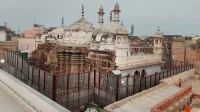
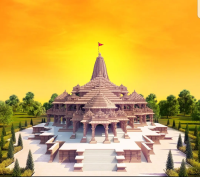
It is not just for “political reasons” that Hindus want to build grand
temples at the sites of the (wrecked) Babri Masjid in Ayodhya, the
Gyanvapi mosque in Varanasi, and the Mathura idgah. The efforts of
religion-intoxicate d and politically active Hindus to rebuild the Ram
Mandir, the Kashi Vishwanath Mandir, and the Krishna Mandir are just
three episodes m a one-thousand year long Hindu struggle to reclaim
their culture and religion from alien invaders.

The demolition of the Babri Masjid in Ayodhya on 6 December 1992 was
just one episode in the millennial struggle of the Hindus to repossess
their religion-centered culture and nation. Meanwhile, hundreds of
ancient Hindu temples forsaken all over Hindustan await the
reawakening of Hindu cultural pride to be repaired or rebuilt and
restored to their original, ancient glory.

This article was published in Hindustan Times on December 28, 1997

———— ——— ——— ——— ——— ——— -

Rizwan Salim is a reviewer of New York Tribune, Capitol Hill reporter,
assistant editor of American Sentinel.

Seva Bharati 2nd phase Relief Program for Mahaboobnagar District.

October 17, 2009 by arisebharat

Seva Bharati has completed flood relief works worth about Rs.1.2 crores in its 1st phase flood relief work in Mahabubnagar.  In order to further rehabilitate the victims, the following proposals are being envisaged. 

  1. To support the handloom workers who have lost their looms (maggams) and material. This is their only source of livelihood and it is planned to provide partial or full support for purchasing looms (maggams) or other material. This is in addition to the grants provided by the government. It is planned to provide 6000 maggams. Support for each family would cost between Rs.10,000/- to Rs.30,000/- based on the loss to them.


  1. Rehabilitation : Seva Bharati has a proposal to support and provide accommodation and additional facilities such as modern toilets and community septic tanks.


  1. To support required instruments to the carpenters, tailors and other artisan groups in the villages.


  1. To encourage the farmers to form a co-op society and develop micro finance system. Seva Bharati would also encourage them to adopt organic farming.


  1. To provide 1,00,000 school kits to the students who have lost their books and other material in the floods. To also arrange study centers and special coaching to the high school students.


  1. To adopt two villages,
    1. a. Ayyavanipally and
    2. b. Chinna Gummadam

These villages were totally washed away in the recent floods and Seva Bharati would rehabilitate the families by supporting them in all aspects. This is in addition to the grants provided by the government in Grama Vikas Yojana.

Some media reports on Seva Bharati relief activity at http://vskap.blogspot.com/2009/10/appeal-for-help.html

Inspiring Incident

October 8, 2009 by arisebharat
Dear All
 
Our office assistant Bhaskar’s home is at Kurnool and his family was also affected by the floods. His family members were all staying in our relief camp at G.Pulla reddy Engineering College, Kurnool while he was in Hyderabad.
 
We decided to raise some funds for him within the office and managed to raise a decent amount.
 
He is a swayamsevak and constantly refused to take the money. But when we insisted, he said, he would like to re-donate 30% of the money back to Seva Bharati since there are many more who are affected.
 
I am sure as we get feedback from the relief work, we would get many more inspiring incidents from field.
 
dhanyavaad
Ayush

School kits for Flood Affected Children

October 7, 2009 by arisebharat

  School Kit Sponsorship Aims at Providing School Kits ( Bags,Notebooks,geometry box, Pen, pencil, Sharpener, Eraser) to the financially challenged Flood affected children.

Each school kit cost Rs.200/-.

You can also draw a cheque/draft in the name of Seva Bharathi

Contact sewabharathi@gmail.com for more details on logistics.

dhanyavaad

Ayush

Flood Relief Kits

October 5, 2009 by arisebharat

Namaste

After a survey of the affected areas, it has been decided to create a Flood relief kit.

a. 3 sets of cooking utensils, two plates and glasses,

b. 10kg rice, 1kg dal, 1/2 kg tamarind, 1/4 kg masala powder,

c. 1 blanket and 1 mat.

The Overall cost – Rs.1,200/- per kit.

Kindly contact for any help that you would like to render.

 dhanyavaad
Ayush

Flood Relief Activity in Kurnool, Mahabubnagar by Seva Bharati

October 3, 2009 by arisebharat


pic 4jpic 2 j

http://www.youtube.com/watch?v=t-p154XmF5w

Media News

At least 130 people have been killed in Andhra Pradesh and neighboring Karnataka due to floods resulting from heavy rains since Wednesday (1st Oct). Andhra Pradesh is facing the worst ever floods in its 60 years, as 60 per cent of Kurnool district was submerged on Friday leaving thousands homeless and stranded without food and water. Nearly two lakh people have been evacuated to relief camps in the worst-affected districts of Kurnool, Mahabubnagar and Krishna district.


The gates of several projects on the Krishna river — including Jurala, Srisailam, Nagarjuna Sagar and Prakasham — have been opened to release the flood water. While the inflow into Srisailam reservoir has touched an all-time high of 21 lakh cusecs, 10 lakh cusecs of water has been discharged from Srisailam and Nagarjuna Sagar reservoirs.


“This is a never-before-seen situation. Never in the past has the Krishna basin witnessed such floods and inflow of water into the dams. I am urging the people in the low-lying areas not to take the threat lightly. Move out to the safer places and cooperate with the officials,” said the State Revenue Minister Dharmana Prasad Rao in Hyderabad.


Army boats and Air Force helicopters Friday began to rescue hundreds of people marooned at several places. Thousands have been rendered homeless. Over 40,000 houses have been damaged. Chief Minister K. Rosaiah said the flood situation was grim and army personnel have been deployed for rescue operations. Six helicopters have been pressed into service to rescue people. While four helicopters are being used to airlift the flood-hit in Kurnool district, two choppers were deployed in Mahabubnagar district.

 Preliminary first hand report from Seva Bharati Team

Seva Bharati volunteers have already started launching relief camps in affected towns of AP & Karnataka and now food is being provided to the people. As per the preliminary report received from volunteers for below 2 districts the situation is as below:


Kurnool District:

Affected Data

- Total 8 Revenue Mandals
- About 6 lakh people
- About 1,00,00 acre crop
- Kurnool town 50% affected (2.5lakh people)
- Mantralaya – famous temple of Raghavendra Swamy completely immersed in water. ( now cleared).

Relief Centre in Kurnool town being organised at G.Pulla Reddy Engineering College.

About 60,000 Food packets are being carried from Nandyala and neighbouring mandals to the relief centre.


Palamoor District (Mahabubnagar District):
Affected Data

-Total 2 Revenue Mandals
- About 2 lakh people
- About 5,000 acre crop
- 130 small lakes got cut due to floods causing at least 130-150 villages completely sub-merging in water.

15 relief centres.


How to contribute

A time for action is here again. Let us donate generously for the relief and rehabilitation of the affected people many of whom have lost everything overnight.


Online transfer of funds can be done to Seva Bharathi A/c No: : 2010036679 , Syndicate bank,. Branch code 3017.

, Kachiguda Railway station branch, Hyderabad;

Or Seva Bharati A/C No: 630501065297, ICICI Bank, Himayatnagar Branch, Hyderabad

You can also draw a cheque/draft in the name of Seva Bharathi and post/courier it to below address

SEVA BHARATHI

H No:3-2-106,

Nimboliadda, Hyderabad 50007

Ph: +91-040-24610056

Mob: + 91 9701226830, +91 9849262868

 [Please note that all contributions to Seva Bharathi are tax-exempt under 80G.]


If you are interested in joining the Seva Bharathi team at ground zero, please send email to sewabharathi@gmail.com or arisebharat@gmail.com

http://sevabharathi.blogspot.com/

 Him I call a Mahatma whose heart bleeds for the poor – Swami Vivekananda

Nanaji makes Gramswaraj a reality

September 29, 2009 by arisebharat

Nanaji makes Gramswaraj a reality
The savant of Chitrakoot
By Sangeet Verma

Chitrakoot is famous for its significant role in the exile of Sri Rama. It was in these forests of Chitrakoot that Sri Rama spent a large time of his exile. This made Chitrakoot a place of devotion and faith for Hindus worldwide. However in recent years, apart from its religious significance, life for the villagers in this holy place gradually lost relevance with the teachings of Sri Rama. The dense forests disappeared with time, agriculture lost its profitability and governance was limited to tax collections and VIP visits. Poverty grew with increasing unemployment and water shortage ruined agriculture. Bandits controlled the area and spirituality shrunk to religious shrines and temples. By the early seventies, Chitrakoot became a dry and poverty-struck area with temples and shrines as the only source of income.

It was in 1969 that Nanaji Deshmukh visited Chitrakoot. He was moved to see the pathetic condition of the society in the karmabhoomi of Sri Rama. He sat by the holy river Mandakini, and resolved to change the picture of Chitrakoot. Nanaji gave up an illustrious political carrier, politely refusing a ministerial birth offered by the then Prime Minister Morarji Desai and announced his retirement from active politics. He returned to Chitrakoot to lay down the foundation of Deendayal Research Institute now famous as DRI. Named after the famous thinker and organiser Deendayal Upadhyaya and designed to implement development programmes through his vision of ‘Integral Humansim’, DRI was aimed at rural development and research, targeting villages around Chitrakoot. Nanaji laid down the objectives of DRI, aiming at complete independence of villages and villagers in agriculture, water resources, health, moral character, education and employment. His vision was to design a system of development based on local knowledge and technology and enhancing the same for the prosperity of the locals rather than invite external investments. The challenges were massive and the primary challenge was to win over the trust of the villagers in order to prepare them for the change.

Work started with minimum resources and maximum efforts. The primary focus was on making agriculture a profitable venture as Nanaji believed that only prosperity can make a happy society. A meeting of farmers from 19 villages was called and a decision to create local dams to sustain rainwater was taken. Men, women and children contributed to the call and before the rains could arrive, dams had come up in every possible location. Interestingly, no cement, concrete or iron was used for the purpose and only local stones and mud was used. Many ‘leaders’ laughed at the idea and said that these dams will not even stand the first rains. But they did, and are strongly standing till date. The experiment has recharged the entire ground water system around Chitrakoot and even in the months of May and June, local wells carry 10-15 feet of water. Nanaji went further to launch Krishi Vikas Kendras (KVKs) resource and research centres aimed at transforming unprofitable landholdings of poor farmers into profitable ones. The KVKs helped the poor farmers harvest rainwater, use latest methods of agriculture and provided knowledge and resources for the same. They also created Seed Villages in a cluster of villages and Seed Clubs at village levels where farmers could get better seeds for better yields in their own villages, rather than awaiting government machinery to supply them. These villages are now not only meeting the seeds requirements of their own village but also supplying the surplus seeds to nearby villages that provide good income to the growers. The members of the Seed Clubs exchange their seeds for food grains within the village (for1 kg seed they take 1.25 kg food grain from farmers).

Nanaji’s focus on education was clear since the time he established the first Saraswati Shishu Mandir in Gorakhpur in his days as a Pracharak. In Chitrakoot, he has ensured that not only do the students get good education to earn a happy living, the same education evolves them as responsible citizens and integral components of a happy human race and not just money making machines that work under the pressure of a mad market frenzy. The pre-primary education begins at Nanhi Duniya or the ‘little world’ where children in the age of 3 to 5 years come not to study, but to experience nature. They play with everything from colours, balloons to geographic models, maps and toys, and learn by interaction rather than reading and writing. Nanhi Duniya is an interactive world that teaches important lessons of the world to toddlers while playing with nature. It has interactive and play-based models and galleries on themes of geography, history, zoology, sports and yoga, swimming, words and numbers, and art and creativity. Primary education in Chitrakoot begins at Surendra Pal Vidyalaya where the children study standard curriculum. The hostel accommodations here are designed as family units. Ten students stay in a flat as a family, with their responsibility assigned to an aged couple called Guru Mata-Pita who ensure that the children get a family atmosphere and do not feel isolated in a big world. They are also responsible for inculcating cultural and moral values in these children. Each family is provided with a cook. For post secondary education, Nanaji founded the first rural university in India, the Mahatma Gandhi Chitrakoot Gramodaya Vishwavidyalaya. This university has state-of-the-art courses and equipments, including a fully equipped Geographical Information System Lab in its Geology department.

Nanaji believed that only a healthy society can be prosperous. Thus came into existence the Aarogya Dhaam, a world class comprehensive health care and research centre that focuses on serving through naturopathy, yoga, and Ayurveda. The many components of Aarogya Dhaam include the Aayurveda Sadan (meant for Ayurvedic treatments and research), The Nidan Sadan (Out Patients Department), The Yoga Sadan (for yogic cure and training), the Ras Shala (where locally grown herbs are used for preparing ayuvedic medicines), Swasthya Kutir (health cottages that offer five star facilities with programmes for healthy physical, mental and emotional recovery), Matri Sadan (maternity and paediatric unit), Swasthya Sadan (In Patients Department), a fully furnished dental unit, Aahar Vihar Sadan (canteen), a spawning herbal garden spreading many acres, and a large library and documentation centre. Located on the hills of Chitrakoot surrounded by forests and overlooking the holy Kamtanathji mountain, this health centre with its lush green lawns, gushing waterfalls and picturesque surroundings are a feast to the eye. It is clearly aimed at handing over a suffering body to mother nature, mentally, emotionally, spiritually and physically, helping it with the very components derived from nature in the form of herbal medicines and cure, thereby bringing a comprehensive recovery of the entire human system that heals the mind, body, heart and soul, permanently. The DRI has also developed and designed a pack of 34 local herbal medicines that are derived from local knowledge and have been found to be very effective in curing frequently occurring ailments and diseases. They call it Dadi Maa Ka Batua. This kit has gained tremendous popularity in the villages and has helped save the villagers from expensive treatment and medicines. Adjacent to the Aarogya Dhaam is a well-maintained and well-equipped Gau Shaala where cows of different Indian breeds are kept and conservation of superior genetic germ plasm and their propagation for milk production and agricultural needs is done, specially for breeds which are in danger of extinction. The Gau Shaala is also engaged in maintaining pure Indian breeds through artificial insemination of cows and bullocks for better and quality milk production in order to make the Indian cow an economically feasible, useful and profitable option.

Nanaji’s commitment to Chitrakoot further extends to its people in addressing their employment needs. His vision of providing local options of livelihood with minimum investment and maximum profits resulted in the institutionalisation of Udyamita Vidyapeeth, an entrepreneurship development and research centre that works round the clock for developing, training, and establishing low cost and high income enterprises in the rural areas with the help of self-help groups and individuals. At present this industrial training centre is providing training on fruits and vegetable processing, dal poha and lai production, oil expeller units, readymade garments, screen and offset printing, MCR tiles, sakar blocks, processing of cereals and pulses industry (PCPI), flour mills, cane and bamboo craft, fabrication, computer training, bakery products, soap and detergent production, hand made paper making, and radio electronics. Rural youth from all over the region come here and get trained in the areas of their individual interest. Training is provided in state-of-the-art class rooms and laboratories that help them understand every aspect of their future livelihood. They then go to their respective villages and establish the ventures giving employment to themselves and many others. The focus in designing all industrial solutions is keeping them a low investment enterprise based on local raw materials in order to ensure sustained supplies and profits.

A prosperous society is incomplete without its moral and cultural values. DRI has set-up Ram Darshan, a unique interpretation centre of the Ramayana, based on the life and teachings of Sri Rama. Through its unmatched paintings, sculptures, collections and crafts, Ram Darshan not only looks deeper into the meaning of Ramayana, it helps one understand the universal acceptability of his teachings and their relevance in today’s life and society. It is a mirror that tells us where we went wrong, and how the course can be corrected. It is a bridge that connects the islands of religion, knowledge, karma and spirituality for the supreme benefit of a glorious society. In order to ensure that his good work is sustainable, Nanaji, who is now 93, has introduced Samaj Shilpi Dampattis, newly wed graduate couples who have a commitment for community service, that live in the villages and look after the work of DRI in a cluster of five villages. The couples are responsible for overall implementation of the DRI programmes.

It is in Chitrakoot that Nanaji has shown the world that religion is meant more for the benefit of society than individuals. He has proved that pilgrimages like Chitrakoot should not just be places of worship, but also icons of development and self reliance. He has shown that ideals of Integral Humanism as propagated by thinkers like Pandit Deendayal Upadhayaya, can be made a living reality. Gandhiji’s dream of Gram Swaraj has finally been brought true, not by a congressman, but by a swayamsewak. Last but not the least, Nanajii has shown this generation what is meant by the life of a sage spent in penance.

(Comments welcome on vermasangeet@rediffmail.com)

9/11 – The comparison between Civilizational values

September 11, 2009 by arisebharat

Namaste All

9/11 marks an important date in World history. Swami Vivekananda made his historic speech at Chicago on this day, 1893 wherein the World Parliament of Religions was won over by his charm as he presented the Hindu philosophy and how we gave refuge to the persecuted Jews and Parsis. He also warned about the dangers of fanaticism and bigotry.

On 9/11, 2001, on the same day, a sample of religious fanaticism of Abrahamic religions was demonstrated to the world- destruction of the World Trade Centre in America.

For the sake of world peace, it is important that the voice of the Hindus is heard across the world and that can happen only by a strong, resurgent Bharat because the world only listens to the strong.

Arise Bharat.

dhanyavaad
Ayush

Swami Vivekananda’s speech http://www.youtube.com/watch?v=lxUzKoIt5aM